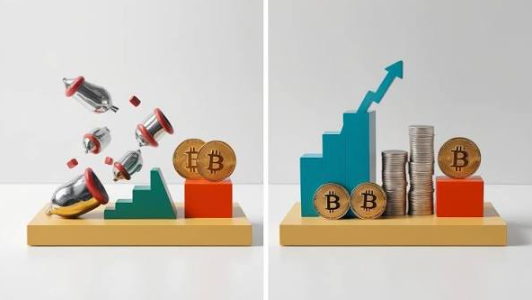

Inflationary tokens issue new supply over time, expanding total circulating amounts and pressuring per-unit price if demand does not track issuance. Deflationary designs cap or burn supply, creating scarcity signals that may sustain or raise value with steady demand. The mechanics—reward rates, burn throughput, and minting ceilings—determine long-run price pressure, governance resilience, and holder concentration. Each framework implies distinct risk profiles and incentives; the implications for capital allocation remain contingent on adoption, utility, and enforcement mechanisms that follow.
Inflationary vs Deflationary Tokenomics: Foundational Definitions
Inflationary and deflationary tokenomics describe two contrasting economic regimes for crypto tokens. The analysis distinguishes issuance schedules, supply growth, and price impact, quantified by annualized inflation rates and projected max supply.
Inflationary versus models show growth through minting and emissions, while deflationary frameworks rely on burning, capped minting, and scarcity. Token buybacks can reduce float, signaling commitment to price-supportive dynamics.
See also: The Difference Between Fungible and Non-Fungible Tokens
How Incentives Work: Rewards, Burns, and Supply Caps
How incentives shape token dynamics hinge on the interplay between rewards issuance, on-chain burning, and explicit supply caps.
The model quantifies reward issuance rates, burn throughput, and cap adherence to assess incentive misalignment, governance risk, and equilibriumToken velocity.
Deflationary structures bias holder concentration, while inflationary schemes constrain burn effectiveness; both require robust governance to minimize misalignment and preserve long-run stability.
Risk, Viability, and Long-Term Considerations
From the prior discussion of incentives, it follows that risk, viability, and long-term considerations must be assessed through a quantitative lens that links reward issuance, burn throughput, and cap adherence to downstream outcomes such as holder concentration, price stability, and governance resilience.
Volatility drivers and governance dynamics constrain viability, demanding robust sensitivity analyses, transparent metrics, and disciplined cap maintenance to sustain durable, freedom-oriented ecosystems.
A Practical Framework for Token Selection
The approach emphasizes quantifiable metrics, sensitivity analysis, and scenario testing for inflationary governance and deflationary staking incentives.
It supports transparent benchmarking, risk-adjusted return assessment, and governance resilience, promoting disciplined decision-making and freedom-oriented stakeholder alignment.
Conclusion
In inflationary versus deflationary tokenomics, outcomes hinge on supply tempo and demand persistence. Inflation fuels ongoing issuance, sustaining validators and liquidity but eroding per-token value absent absorption; deflation constrains supply and amplifies scarcity, potentially elevating price with stable demand. Juxtaposing growth propulsion against value retention reveals a tradeoff: rapid expansion risks dilution, while scarcity commands resilience only if demand remains robust. Ultimately, token selection mirrors risk tolerance: continuous earners with discipline, or scarce stores with disciplined capture.